Guard’s death and narrator’s arrest on the Tokwe test night
The IPCRESS FileThe Guard’s death and narrator’s arrest on the Tokwe test night marks the shift from a dangerous, confusing night operation to an official accusation of murder. The narrator is found near the test site after a flare draws police helicopters to Shot Island; a dead soldier is discovered in the camera tower, and the narrator is arrested. By morning, the Brigadier identifies the soldier as Corporal Steve Harmon and says the narrator killed him. The accusation is not presented as a settled account of what happened, but as the charged starting point for an inquiry into the death and the narrator’s alleged connection to a Russian submarine.
The flare and the arrival of the police
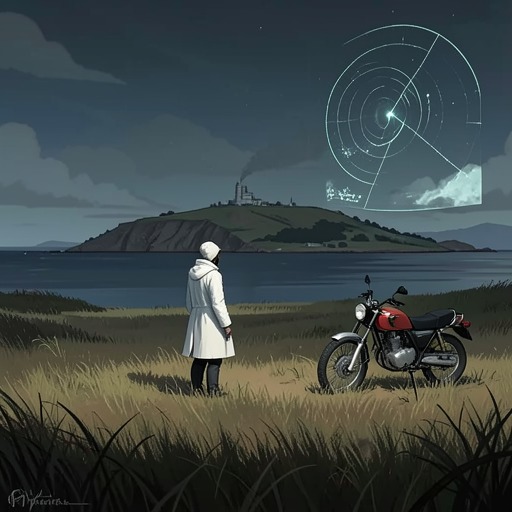
After leaving the car, the narrator experiences a sudden lull before hearing a siren from the far side of the island. Two police helicopters approach and drop hand grenades into the sea while sweeping the area with large spotlights. The Air Police have located the flare and flown toward its light; the passage establishes that the flare has brought them to the scene, without explaining who fired it.
One helicopter turns back toward the narrator. At 2:17, as its spotlight blinds him, a voice from a loudspeaker tells him not to move. He sits still while the two aircraft search different parts of the site. The sequence places him under immediate scrutiny before the narrative explains why he is treated as a suspect: the police lights are moving across both his car and the tower, where the fatality is about to become visible.
The tower and the arrest
The second helicopter’s beam passes over the high-tension lines and the camera tower, then climbs the tower’s steel ladder. The narrator sees a dead soldier half outside the smashed window. He understands the death as connected to the tower’s electrical installation: the metal structure is attached to a high-tension power line by angle irons and bolts. The account gives the physical circumstances of the discovery, but does not establish in this scene precisely how the soldier came to be there or the full sequence that caused his death.
At about 2:36 a.m., a Provost-Colonel arrives to arrest the narrator. Half a minute later, the narrator remembers the large insulating gauntlets. His belated recollection carries an immediate sense of missed possibility, but he also doubts that remembering sooner would have enabled him to change anything. The arrest therefore follows the discovery quickly, while the narrator’s own account leaves open what he could have done and what responsibility he bears.
Identification and accusation
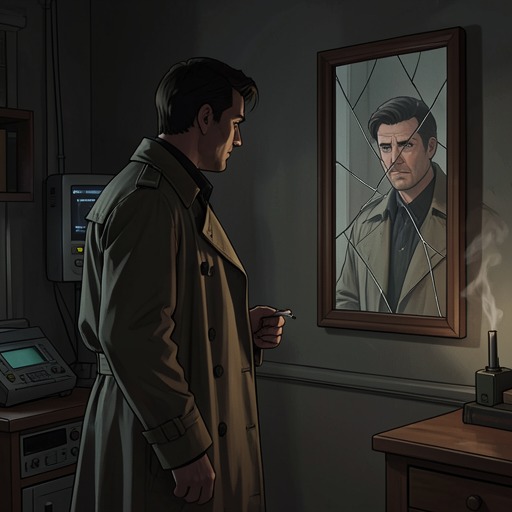
The later scene in Waiting Room No. 3 makes the death personal and explicit. The narrator returns to the room in daylight, with the chair, telephone, magazines, and stretcher still in place. On the stretcher lies a corpse; the Brigadier identifies him as Corporal Steve Harmon and tells the narrator that he was the man killed the previous night. The familiar room has become the setting for a direct accusation, turning the arrest into a question of culpability rather than merely a response to the narrator’s presence at the site.
Over the following twenty-four hours, the narrator spends about fourteen with the Brigadier, while doctors and psychiatrists also examine him. In the Brigadier’s office, coffee and toasted bacon sandwiches accompany a long silence before the Brigadier explains how the narrator is classified in his dossier: three stars mark him as a particularly serious potential danger, but also serve, in the Brigadier’s view, as a rough indication of investigative skill. The Brigadier says he wants to believe the narrator’s denial that he signalled to a Russian submarine on Thursday night and asks him to present his information and account. The interrogation thus joins the death at the tower to a separate suspicion about the submarine, without resolving either question in the available scene.
The event’s unresolved turn
The narrator believes the Brigadier is being kinder than his role requires, despite being convinced that the narrator connected the tower to the electric line and caused the policeman’s death. Yet the narrator does not simply accept the Brigadier’s account of the submarine incident: he remains unconvinced that the submarine did not fire its own flare. The event’s significance lies in this unresolved double suspicion. A flare has drawn the Air Police to the island; a dead soldier has led to the narrator’s arrest; and the Brigadier’s effort to assess the narrator folds the arrest into a wider intelligence inquiry. The accusation is concrete, but the narrator’s responsibility and the flare’s origin remain unsettled.